

“To have enough, you must have too much.” Have you heard it said?
Years ago I read this quote applied to growing food, and it began to ring true the longer I maintained a kitchen garden. Inevitably, if you plant just enough to produce what you believe you will eat, you come up short.
In reaction, each spring we plant more than we know we will eat, and often end up with even more than that. And sometimes still… less.
Balance rarely found.
Home gardening is imprecise. It’s always too much or not enough… and that’s where preserving comes in. We find ways to extend the “too much” to get us through the “not enough.”
But it can go kind of wrong…
When we aren’t strategic about what we grow in the first place, and, when we are overly ambitious about what we can preserve, we end up with mountains of tomatoes destined for home-canned sauce (that we never make) or bags of raw kale (languishing in the freezer).
Or we just start giving away every unwanted zucchini. (That was me.)
But a few years ago, I started keeping a notebook of harvest preservation successes, and this was my rubric for inclusion: The only things I would allow myself to write in the book were the things I used up—happily.
The aforementioned raw kale, along with some roasted and pureed butternut squash, did not make it in the book. I forgot those things were in the freezer.
But the basil oil, the no-peeling-required tomato sauce, the sage brown butter, the lemongrass and peppermint teas, the dried lavender, red pepper flake, and oregano… they all went in the notebook because I reached for them again and again until they were gone. They proved their value.
The trick, I’ve learned, is developing a mentality towards preserving that includes two things:
knowing how you will use it, and knowing that you will use it, before you save it
having a repertoire of simple hacks that don’t require a lot of preparation, fancy equipment, or time
Develop that mentality, and you will start choosing what to grow based on what you know you will eat and will realistically have time to preserve.
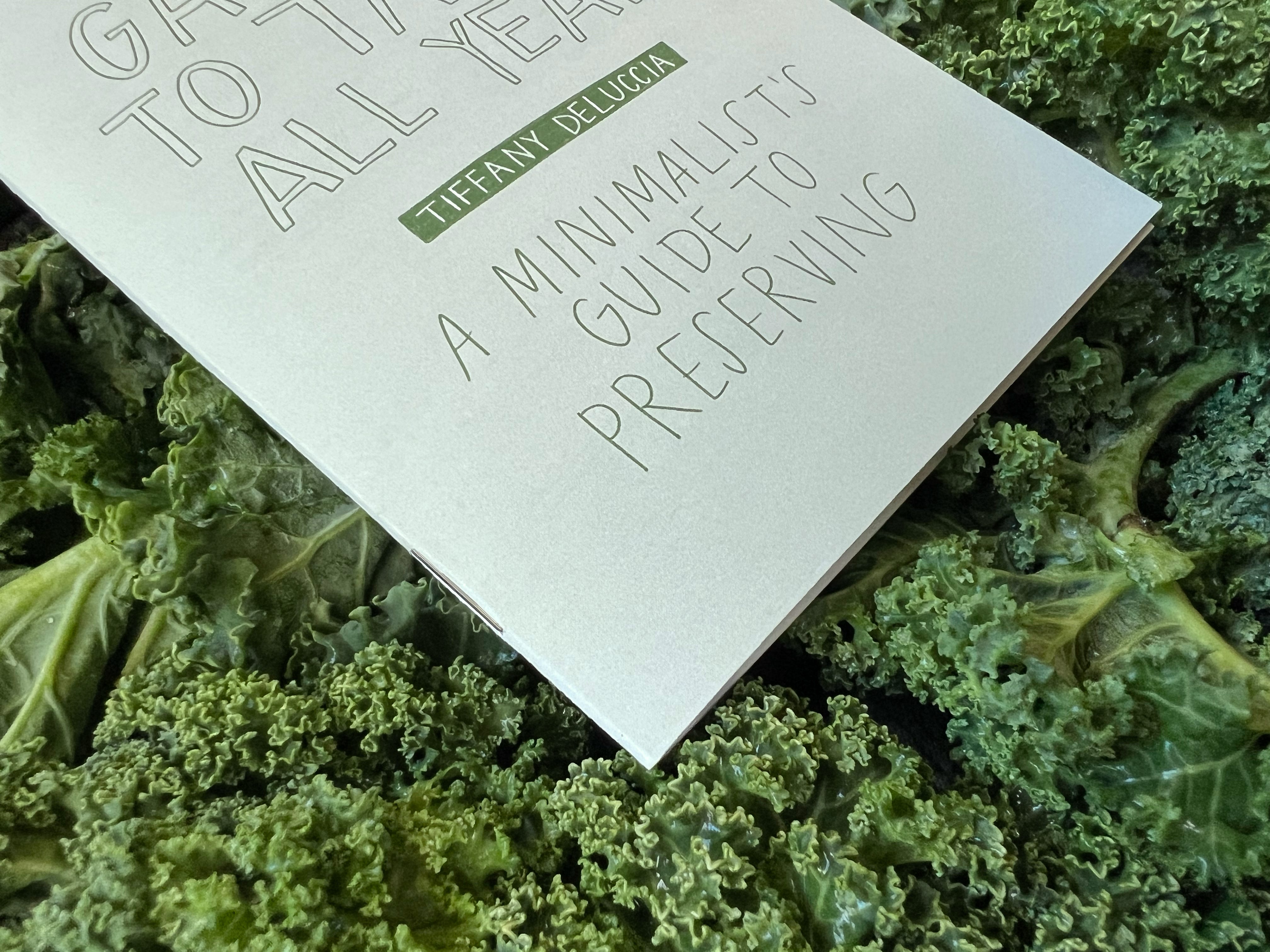
And with that preamble, let me introduce you to a new little zine I wrote in collaboration with Good Printed Things to share six simple ways to preserve what you grow—easy-to-execute methods for turning the abundance of any particular thriving thing in your garden into something you’ll be excited to consume later, without exhausting yourself. (You are, of course, already putting a lot of energy into the growing part!)
Garden to Table All Year:
A Minimalist’s Guide to Preserving


No method requires fancy canning equipment or a dehydrator. Some only ask you to reference the size of your pot for measurements, or are simple to memorize as a basic ratio. Some are as easy as hanging something up to dry.
I hope these methods feel simple enough to encourage experimentation: I share foundational concepts and ways I have applied them, but you can take it and run with it. It’s small enough to tuck into a preserving notebook of your own and keep on a shelf in the kitchen.
Garden to Table All Year is available for the first time today—and if I say so myself, it’s incredibly cute. Get the zine here!
Read on for details about a spring Plant Share event, where to buy plants this spring, and a few books and podcasts I've been into.
Balance rarely found. Home gardening is imprecise. It’s always too much or not enough… and that’s where preserving comes in.
Spring 2026

What I’m Reading & Listening To
The Joe Gardener Podcast - Episode 456 Food Preservation for Gardeners
We already had the zine done when I heard this episode interviewing Staci and Jeremy Hill, authors of The Preserver’s Garden. My little zine will get you started—their book would help you go all in.
The Complete Guide to Home Permaculture
Brandy Hall
I just finished it: Extremely practical. Brandy gives you detailed instructions for building swails and rain gardens, and developing soil in problem areas of your land, like slopes. If you are interested in sustainability and permaculture but aren’t sure where to start, this book is accessible to the home gardener.
This and That
Spring Plant Share with Mill Village Farms
Saturday, May 2 from 10am - 1pm, join me for a spring plant sharing event.
I’m thrilled these little events have picked up momentum and that we’re able to keep doing them each year. If you’ve never been to one, this is all you need to know: We’re giving away free plants.
Cuttings of houseplants, divisions of perennials and bulbs, seeds, seedlings, sometimes full on trees. People who have, bring things to share. People who don’t, unabashedly receive. That’s why we don’t call it a “swap” anymore…you’re welcome even if you don’t have a plant to trade.
I’ll have a table at Mill Village’s Block Party: Hope to see you there!
1186 Pendleton Street, Greenville, SC, 29611
Spring Plant Sales
A few of the best places to get plants this spring:
South Carolina Botanical Garden Spring Plant Sale
When: April 11, 2026 (9 AM-1 PM) and April 25, 2026 (9 AM-1 PM)
Highlights: Extensive native plants, trees, perennials, and shrubs, with expert staff available.
Greater Greenville Master Gardeners Plant Sale
When: April 25, 2026, 8 AM - Noon
Highlights: A wide selection of healthy plants at bargain prices.
South Carolina Native Plant Society (SCNPS) Upstate Sale
When: April 18, 2026, 9 AM - 1 PM
Highlights: Specialty native plants for local landscapes.
Find other vetted places to buy plants here in Upstate, SC in the map I helped develop: Paper Routes - Plants Map

What I’m Growing

A list of what is actively growing in my kitchen garden right now (not counting warm season seedlings… it would just get too long).
Blueberries
Carrots
Garlic
Greens: Arugula, Buttercrunch, Lacinato Kale, Romaine, Spinach, and Winter Rouge
Herbs: Rosemary, thyme, chives, cutting celery, green onion, parsley, peppermint and sage.
Meyer lemon
Radishes
Strawberries
Springs Past
On Hope, a Haven of Tranquility, and Allergy Tea

Spring spring spring spring spring! I can’t remember feeling this excited about budding hydrangeas, tiny alyssum sprouts, and little violets everywhere in a very long time.
How to Love on Your Houseplants in March, Seedling Transplanting Tips, Risotto with Garlic Scapes and Asparagus, Growing Veggies in the Shade, and More.

Welcome! I’m thrilled you found the Spring 2022 edition (and the very first edition) of this newsletter.